From NDC to Offers & Orders: What the Next Phase of Airline Retailing Means for Travel Sellers
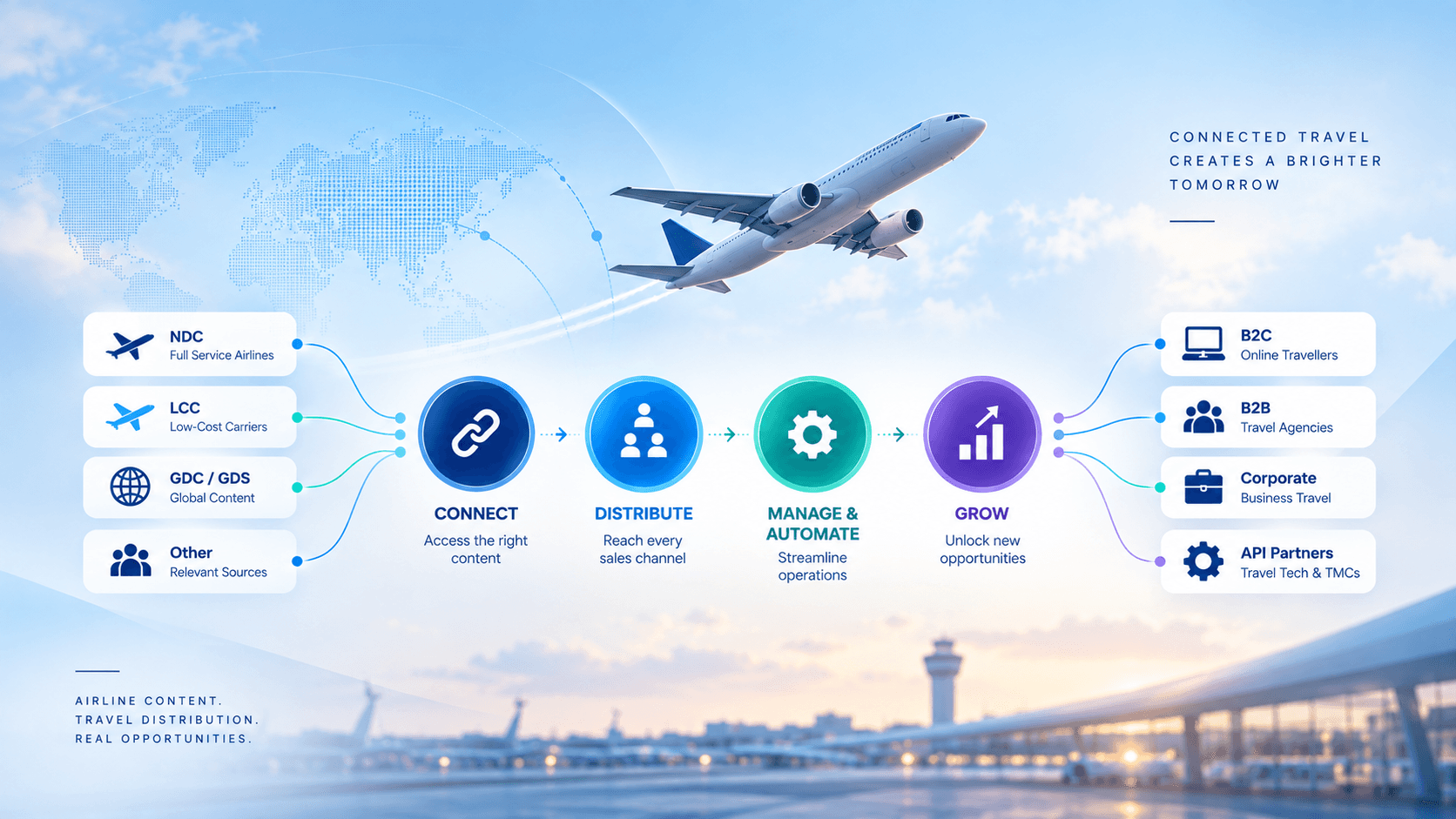
For much of the past decade, conversations about airline distribution modernisation have centred on NDC. Travel sellers have invested in new airline connections, aggregators have worked to bring different implementations together, and airlines have steadily expanded the content and servicing capabilities available through their NDC channels.
That work is far from finished. But the industry is already looking at a broader transformation: Offers & Orders.
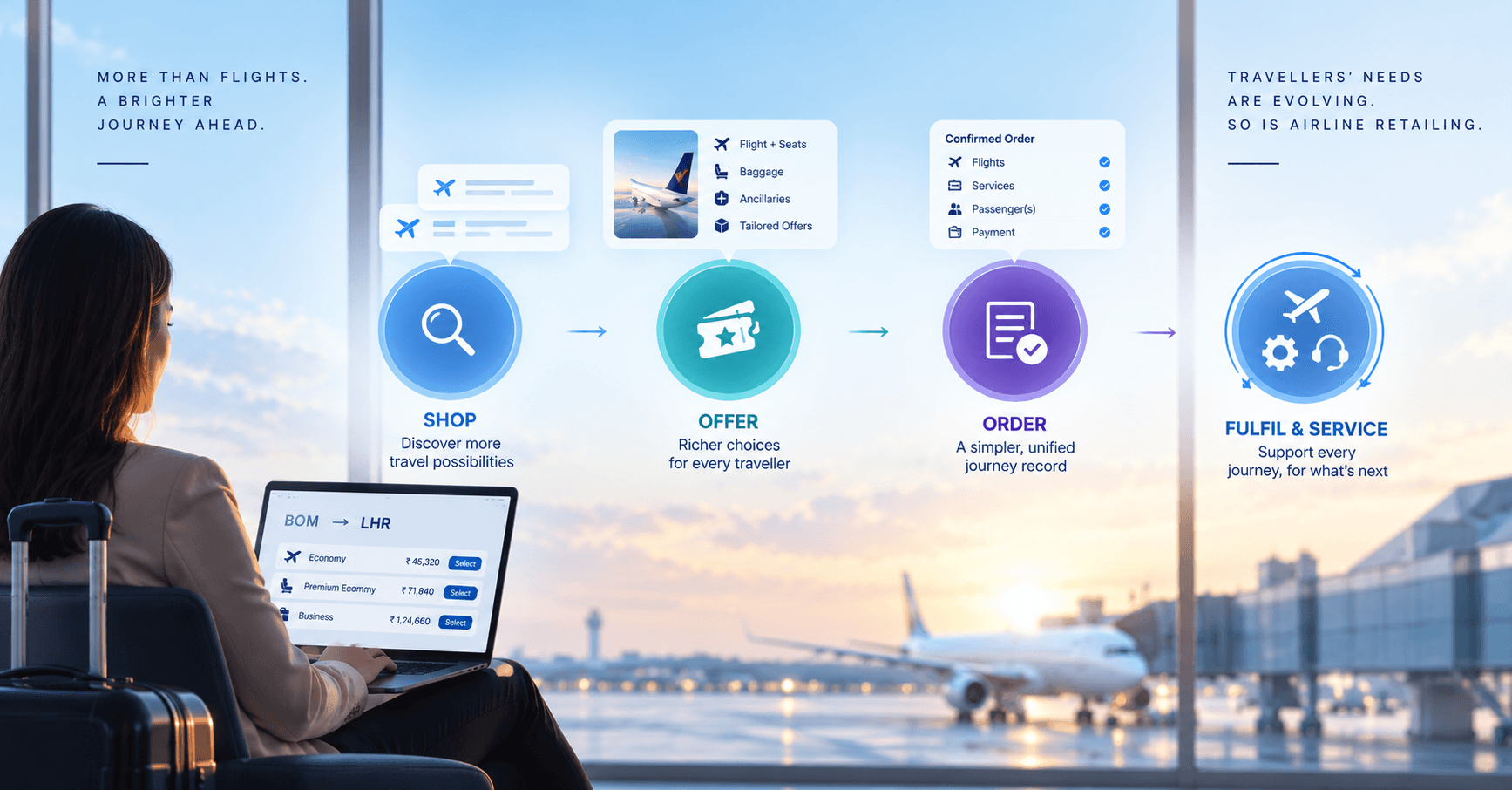
For travel sellers, this should not be viewed as the next acronym to implement after NDC. The more important change is in the underlying retailing model. Airline distribution is gradually moving towards an environment where an airline creates an offer for the customer, that purchase becomes an order, and the same order can remain relevant through fulfilment and servicing.
It is a much bigger change than replacing one API with another.
NDC Opened the Door
One of NDC's most important contributions has been to give airlines greater control over how their products are distributed through third parties.
Instead of every airline product being reduced to broadly similar fare and availability information, airlines can communicate richer offers, including product attributes and applicable ancillary services. Travel sellers, in turn, can present more of what the airline actually intends to sell.
This has already changed what airline connectivity means.
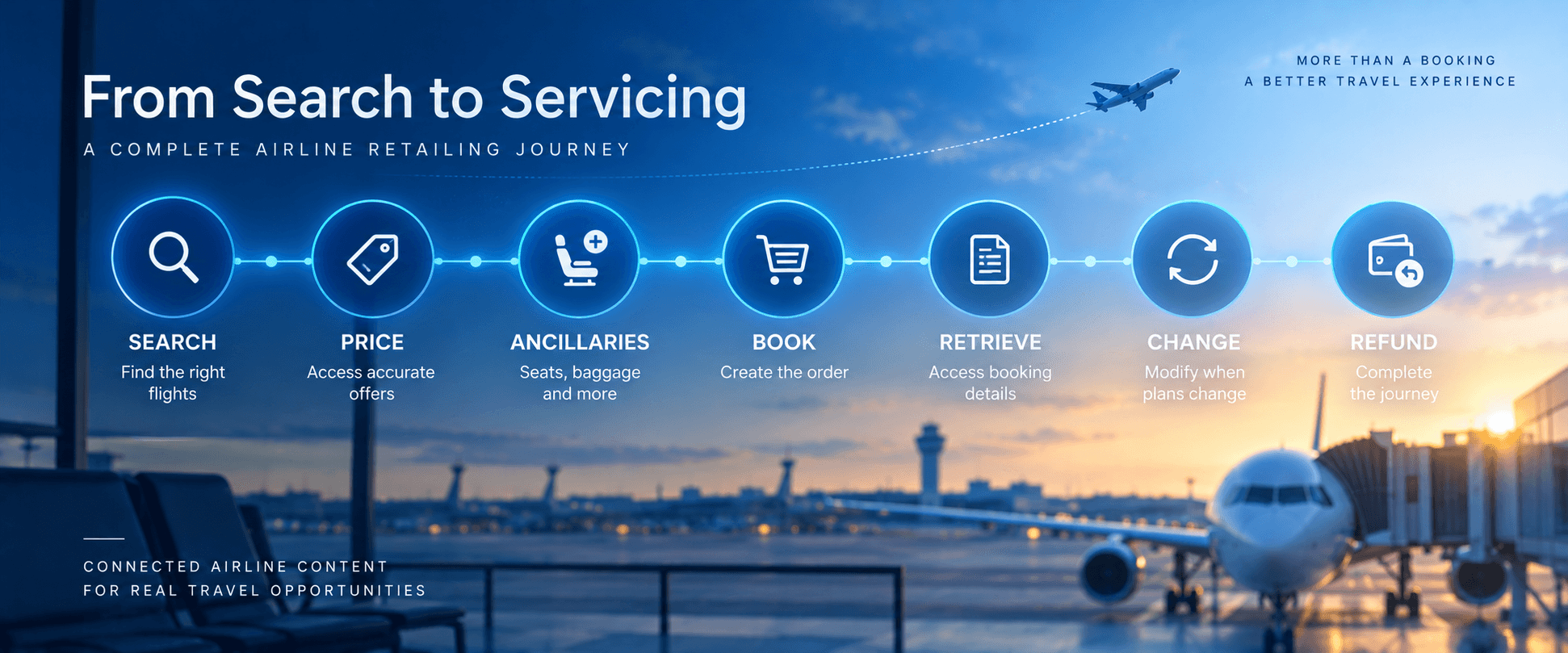
An NDC connection today may need to support considerably more than search and booking. Depending on the airline, sellers may expect branded products, baggage information, seats and other ancillaries, order retrieval, changes and refunds.
The next phase takes this idea further.
The question is no longer only how an airline distributes richer content, but how the complete retailing transaction can work differently from shopping through to servicing.
The Offer Becomes More Important
Consider what happens during a typical flight search.
A traveller is not necessarily looking for a seat between two airports at the lowest available fare. They may care about baggage, flexibility, seat selection, schedule, loyalty benefits or other services associated with the journey.
The direction of modern airline retailing is towards allowing airlines to construct offers that better represent that combination of product, price and services.
Over time, this also creates room for more dynamic offer creation. Rather than relying entirely on predefined products and pricing structures, airlines can potentially respond more intelligently to the context of a shopping request.
For travel sellers, however, richer offers also create a practical responsibility.
An OTA, TMC or booking platform needs to receive those offers, understand their components and present them clearly without losing the differences that make one airline's proposition distinct from another.
That is not simply a connectivity problem. It is a retailing problem.
Orders Could Change the More Difficult Half of the Journey
Shopping receives a great deal of attention in airline distribution, but some of the hardest technology problems appear after the traveller has paid.
Today's airline booking environment can involve reservation records, tickets and separate documents for additional services. When an itinerary changes, these elements may need to remain synchronised through repricing, exchanges, cancellations or refunds.
The industry's move towards Orders is intended to simplify that environment by creating a more unified representation of what the customer has purchased and what subsequently happens to it.
For travel sellers, this is potentially one of the more significant aspects of the transformation.
A booking should not become technologically difficult simply because the customer needs to change it.
If an order-centric model can eventually provide a clearer relationship between the purchase, fulfilment and servicing, the benefits extend beyond the airline. Agents, TMCs, OTAs and the technology platforms supporting them can potentially operate with a more coherent view of the customer journey.
The Transition Will Be Uneven
There is an important practical reality behind all of this: travel sellers will not wake up one morning to find the entire airline industry operating on Offers & Orders.
Airlines are at different stages of retailing maturity. Their technology environments differ, as do their commercial priorities and implementation roadmaps. Existing distribution processes will therefore coexist with newer models for a considerable period.
Travel sellers already recognise this problem from NDC.
Connecting several airlines quickly demonstrates that implementing the same industry standard does not necessarily result in identical workflows. Search behaviour, ancillary capabilities, payment requirements and servicing functions can differ from carrier to carrier.
Offers & Orders will not automatically remove that variation.
In fact, during the transition, technology providers may have to manage several generations of airline retailing simultaneously.
That makes the role of the distribution layer increasingly important. Customer-facing applications should not need to be redesigned every time an airline moves to a different stage of retailing maturity.
Normalise the Complexity, Not the Airline
There is also a balance to maintain.
Standardisation is useful when it removes unnecessary technical complexity. It becomes less useful if it removes the product differentiation airlines are trying to create.
A travel seller needs consistency in areas such as workflow, data structure and integration behaviour, while still being able to recognise and retail the capabilities unique to each airline.
The goal should therefore be to normalise the complexity without normalising the product.
That principle becomes particularly relevant as offers become richer.
The technology between airlines and sellers needs enough abstraction to make multiple connections manageable, but enough flexibility to expose airline-specific products and capabilities where they add value to the customer.
What Should Travel Sellers Be Preparing For?
For travel sellers, preparation for Offers & Orders does not necessarily mean launching another large technology programme today.
It means making current technology decisions with the direction of the industry in mind.
When evaluating airline connectivity, it is worth looking beyond the number of available carriers. How much of the booking lifecycle can actually be supported? Can airline capabilities evolve without requiring major changes downstream? Can richer offers be represented properly? How well can the platform accommodate different servicing workflows?
Architecture matters too.
A booking application tightly coupled to individual airline implementations becomes increasingly difficult to maintain as the number of airlines, channels and retailing models grows. Separating airline connectivity from customer-facing distribution provides more room for both sides to evolve.
This is particularly important during a transition in which traditional processes, NDC and newer Offers & Orders capabilities may all need to coexist.
The Conversation Is Getting Bigger
NDC remains an important part of modern airline distribution. Offers & Orders should not be interpreted as evidence that the industry's work on NDC was temporary or misplaced.
Instead, NDC helped move airline distribution towards a more retailing-oriented model. Offers & Orders extends that thinking across a much larger part of the journey.
For Pratra, this evolution reinforces a principle behind AIRX: airline connectivity needs to be designed around the retailing capabilities that travel sellers actually need, rather than connectivity alone.
The technology between an airline and a seller will continue to change. So will the standards behind it.
What ultimately matters to the traveller is much simpler: Can I find the right journey, understand what I am buying, complete the purchase and get it serviced when my plans change?
Offers & Orders has the potential to bring more of that journey together.
And that is where the next phase of airline retailing becomes much more interesting than another change in airline distribution technology.